Networking-as-a-Service
Transforming Complex Products into Simple Outcomes
In a Nutshell:
The team I led, designed the product experience and developed user interface for MSX, a networking-as-a-service platform for Cisco's largest service provider customers, including Verizon, At&T and Vodafone.
The product experience focussed on transforming key networking actions into composable service outcomes that would integrate across networking domains in the cloud.
1. Create
Technical users create services as automated workflows or with an available SDK.

Business Transformation
In 2016, Cisco began its journey of pivoting from being a terminal licensing, hardware-based company, to a subscription-model, software and service-based company.
This business transformation would be a massive shift in how Cisco engages with customers and brings products to market. It would also require a shift in customer experience and software development practices.
“We believe we will transition more of our revenues to a software and subscription based model and accelerate our shift across our portfolio,”
Cisco CEO Chuck Robbins, Q4 Earnings Call, 2016.
Start-Up Culture
After an earlier attempt at building a Networking-as-a-Service across multiple product development groups was retired, a new engineering leader took over the project and asked me to design the experience from the ground up and lead the development of the user interface.
At the time, I was leading a 43-person UX design and UI development team responsible for the cloud virtualization network portfolio of products. I initially allocated a small portion of my team.
I also decided to personally lead this project, because I believed that customer experience would play a strategic role in the company's transition towards cloud and as-a-service platforms.
The product was now run like a lean software start-up within Cisco. Organizationally, all functions required to develop a platform were contained within this dedicated team. With the absence of organizational stratification, we were able to move fast, deliver working software quickly and collaborate directly with customers.
Service Design with Customers
Our customers were large service providers who wanted to sell networking services to their enterprise customers.
Service providers targeted a non-expert persona with the new networking services. The ability to easily achieve networking outcomes without retaining large networking departments and
on-prem equipment was the value proposition providers made to their enterprise customers.


We devised a simple customer service journey template to facilitate the collaboration of breaking down networking outcomes into consistent as-a-service experiences.
Rapid Service Creation — Modular UI & APIs
As we designed and shipped more services, we wanted to open up and accelerate service development, while maintaining service journey consistency.

My UI development lead engaged with the API development group and built a UI service that enabled service developers to register a new service application and be routed to the right subscription and set-up user flows in the UI using consistent APIs.
Visual Design System and Developer Documentation
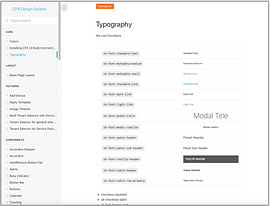


When we started there was no universal Cisco design system for networking products and no universal Cisco library of re-usable UI components. We created our own visual design system, leveraging "Atlantic," the new, unified design language representing the Cisco brand used in outbound marketing at the time and adopted it to a SaaS application sensibility.
The UI engineers on my team developed re-usable, corresponding UI components, using
Angular JS.
We created a website of the design system we created for internal use with design specifications and code examples as a reference for designers and developers.
Brand Adaptability

MSX Theme Builder
Service providers use MSX to sell networking services branded as their own to customers.
The UX/UI team developed "Theme Builder" — a complete UI for business users to adapt the design system to reflect their own brand. Without incurring any development cost.
From Service Applications to Service Outcomes
Initiailly we designed a platform with administrative interactions and separate service applications for specific network services. The model was similar to an app store. It worked well for engineering, because individual applications would be their own software image with only minimal technical dependency on the platform.
Product teams within Cisco liked the notion of "apps" as it translated their stand-alone networking products into stand-alone service applications.
The customer reality was different. Customers wanted to build out their enterprise networks with applications that build on each other. For example, if customers were running three service applications across 100 office branches, they expected to see a single view of their 100 offices, rather than viewing the same sites in three separate service applications screens.
For device management it was similar: Customers wanted to see all their devices and device types in one view, not separated by the context of their application.
With my UX and UI team we evolved the user experience from being centered on the services, where a user jumps off to separate apps, to a model we called "tenant-centric UI."
With the "tenant workspace" customers have a dashboard that affords them complete views of their branch sites and devices. Customers see all their app subscriptions in one view and do not need to leave the workspace for separate application screens. Actions that are common to all applications, such as adding branch sites or onboarding devices, are consolidated.
Integrated Service Management Experience

MSX Tenant Workspace
MSX Tenant Workspace Subscribed services are listed on one screen. Users can expand detail to see the service metrics of each service.
Integrated Site (branch) Experience


All Sites
Site Detail
Detail view of site shows overall status of the site, KPIs of subscribed services and devices present at the site. Site-level actions are accessible with a toolbar top right of the screen.
"Tenant-Centric UI" was developed and shipped. The customer experience of common user capabilities across subscription, set-up, sites and devices created its own dynamic and demand. Now customers expected to mix and match all network management capabilities from still-separate
service apps.
Sites represent branches, or business locations of the customer network. Sites overview shows all sites in the network, regardless of service context.
User Feedback Pushes the Design Further Towards Modular Outcomes
We created a conceptual UX prototype that would resolve individual service offer features into mutually complimentary network actions and KPIs in an integrated network management dashboard.
In the service catalog, each subscription offer had its own feature set. Once subscribed, the features would resolve into consistent user actions and KPIs that built on each other. To validate this UX strategy, that would require significant investment, we usability tested it with a small outside agency.


Dashboard Prototype
Our prototype dashboard shows KPIs such as device compliance and application health and related actions. Users could focus on managing their network in the unified dashboard, while subscriptions were separated into a right-hand sidebar.
Actions from multiple subscriptions were not separated by applications, they were common to the platform and complimented each other.
The study results confirmed this direction. Users had stated application switching as their main pain point with current networking tools. Participants in the usability study enthusiastically embraced the vision of a unified network management dashboard.
Single Pane of Glass
The rapid change in the digital economy towards integrated ecosystems with integrated customer journeys is also shaping the trajectory of the networking industry from isolated point products to connected and extensible customer experiences in a "Single Pane of Glass."
With MSX we had started to solve the significant technical challenges of orchestrating networking services across networking domains such as "WAN", "LAN" and "Wireless," thus creating the back-end architectures that enabled the UX team to connect experiences across previously separate network domain products.
The integrated networking experiences across domains we had created for service provider customers inspired enterprise sales teams to promote MSX to enterprise customers, also.
Integrating customer journeys in a connected ecosystem across networking domains would pose challenges to product development and business processes.
The Other Business Transformation:
From Point Products to Connected Ecosystem
Over the last decade Cisco had successfully extended its product portfolio with an aggressive corporate acquisition strategy. The organization had to balance the value generation of individual product organizations with the growing customer demand for connected solutions.
Initiatives such as consistent look-and-feel across related products are gaining momentum. However, the the idea of common interactions and user flows across product functions posed a much bigger organizational challenge than we had realized, initially.
For example, MSX had unified device management as one of its basic services.
Devices form multiple network domains shared a single view reporting device status and a standardized user flow for device on-boarding.

Device Detail> Integrated Device Status
When trying to roll out unified device status and standardized on-boarding to other product lines, MSX surfaced organizational and operational challenges. Conforming to common API standards for device onboarding — or to share device state across domain controllers — were brand new to product organizations within Cisco.
The technology evolution of integrated platform ecosystems would necessitate a larger organizational shift that needed to be approached in smaller increments.
From Start-Up Incubation to Organizational Maturity
Network product consolidation became the driver for a recent organizational leadership change. Several strategic initiatives were launched. The MSX technology was consolidated with other groups. The user experience organizations were consolidated and a single design system introduced.
We had helped incubate a digital eco-system for networking based on cloud services with large service provider customers. Now the incubation was starting to become subsumed in the larger organizational shift required to complete the journey towards becoming a software and subscription-based company.
The strategic initiatives were focussed and narrow. We produced a quick UX prototype enabling technical users to automate workflows that connected previously disconnected network domains for an executive presentation to the new EVP of the networking product portfolio.
We adopted the new design language and showed three key screens. The new EVP was delighted. Especially when he heard that the technology was already mostly available.


Cross-domain workflow automation mock-up
The Journey Continues
The evolution towards connected, multi-domain networking experiences will continue.
Leading the experience evolution of a service creation platform from individual service apps to connected customer journeys has been am incredibly rewarding learning experience in my career.
My Role
I was accountable for leading the product design, user research and user interface software development - across platform and applications.
In representing the product experience vision end-to-end, I influenced senior business and technical executives.
The UX and UI teams I built, relied on me for vision, initiating collaboration with customers and executive stakeholders; and for creating a protected creative space by providing "air cover" from organizational dynamics.